Artist Reena Ahluwalia's 'Winston Red' Diamond Painting Makes History at Smithsonian
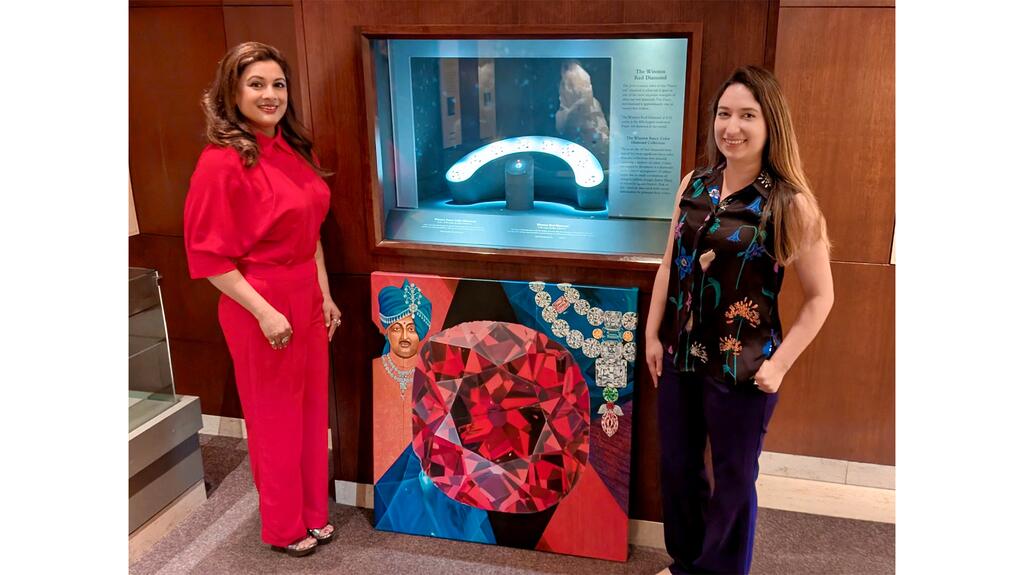
Canadian visual artist Reena Ahluwalia has achieved a significant milestone with her painting, The Legacy of The Winston Red Diamond, becoming the first contemporary artwork to be accessioned into the Smithsonian National Museum of Natural History's esteemed National Gem Collection. The formal acceptance ceremony took place on May 6 in the Janet Annenberg Hooker Hall of Geology, Gems, and Minerals, with Dr. Gabriela Farfan, the Coralyn W. Whitney Curator of Gems and Minerals, receiving the piece.
A Rare Gem and an Unprecedented Acquisition
The painting centers on the ultra-rare “Winston Red” diamond, a 2.33-carat old mine brilliant-cut fancy red diamond. This remarkable stone is the fifth-largest fancy red diamond known to exist and holds the unique distinction of being the only fancy red diamond currently on public exhibition worldwide. The “Winston Red” was gifted to the Smithsonian in 2023 by Ronald Winston, son of the legendary jeweler Harry Winston, and was unveiled in a new exhibit in April 2025.
Ahluwalia's artwork transcends a simple depiction, aiming to create a visual bridge between the diamond's mineralogy, its historical significance, and its cultural symbolism. The composition is inspired by a scientific and historical study of the stone authored by Dr. Farfan and her team, featured in the spring 2025 issue of GIA’s journal, Gems & Gemology. The painting meticulously traces the diamond’s journey, from its probable South American origins to its sale by Jacques Cartier in 1938 to Digvijaysinhji, the Maharaja of Nawanagar, famously known as the “Good Maharaja.” During this period, the diamond was known as the “Raj Red” and was set in the Maharaja's Ceremonial Necklace of Nawanagar, a Cartier masterpiece that later inspired the replica “Toussaint Necklace” featured in the film Ocean's 8. Winston later acquired the diamond from the Maharaja's son in the late 1980s, renaming it the “Winston Red.”
Art as a Medium for Endurance and Resilience
Ahluwalia described her painting as a conceptual study of endurance, translating geological pressure into a visual statement of resilience. The artwork incorporates precise mineralogical markers of the actual “Winston Red” diamond. Throughout her artistic process, Ahluwalia engaged in conversations with both Ronald Winston and Dr. Farfan, absorbing the diamond's scientific data, historical arc, and cultural context.
“Art endures beyond its physical form as an idea whose meaning transcends time,” Ahluwalia stated. “I chose to paint the Winston Red because I felt a responsibility to tell its whole story through an artistic lens. Using the diamond as a philosophical prism, my practice treats minerals as analogues for human resilience—formed under pressure, shaped by circumstance, and resilient through adversity.”
The resulting artwork, which Ahluwalia refers to as part of her broader “Human-Gem Arc” practice, intersects nature, science, and art. It frames the diamond as a vessel of cultural and geological memory, serving to preserve the intangible heritage of the “Winston Red” for future generations. “Ultimately, this painting serves the diamond's history and legacy,” Ahluwalia added. “When art serves a larger purpose, its impact becomes as enduring as the diamond itself. I want it to spark curiosity and inspire the next generation—from gem lovers and historians to mineralogists and Earth scientists.”
A Landmark Addition to the National Gem Collection
The accession of a painting into the National Gem Collection, which houses over 10,000 gemstones and 385,000 mineral specimens, marks an unconventional yet fitting expansion of what the museum considers worthy of preservation. Dr. Farfan accepted the painting at a ceremony held in the Janet Annenberg Hooker Hall of Geology, Gems, and Minerals, acknowledging the artwork's unique role in documenting the diamond's extraordinary story and scientific importance.
Beyond this notable acquisition, Ahluwalia’s artistic contributions to the jewelry and art world include designing the diamond setting for the Legislative Mace of Ontario, Canada, and being featured on a Belgian postage stamp celebrating global diamond heritage. Her works are held in permanent museum collections worldwide.
Sources
- —
- —
- —