Opal: The Gemstone of Play-of-Color
Opal is a captivating gemstone known for its unique and mesmerizing play-of-color, a phenomenon that makes each opal a one-of-a-kind masterpiece. Unlike most gemstones that achieve their color from mineral impurities, opals derive their beauty from the diffraction of light through the microscopic silica spheres that make up their structure. This article delves into the world of opals, exploring their definition, key features, history, types, grading, how to buy them, their value, care, and more.
Definition
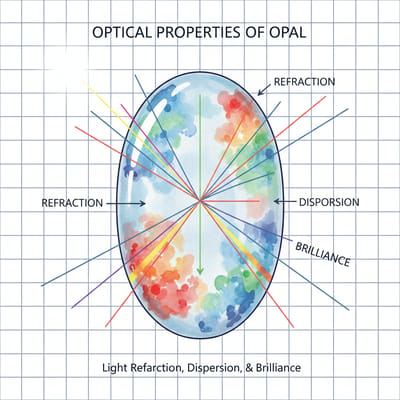
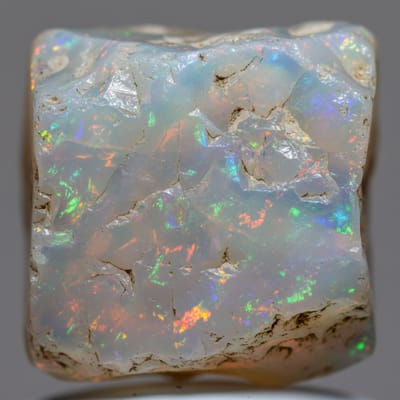
Opal is a hydrated amorphous form of silica (SiO2·nH2O). This means it is a mineraloid, not a true mineral, because it lacks a defined crystalline structure. Its water content typically ranges from 3% to 21% by weight. The most distinctive characteristic of opal is its phenomenon of 'play-of-color', where flashes of spectral colors appear to move across the gemstone as it is tilted. This occurs due to the diffraction of light by the regular arrangement of microscopic silica spheres within the opal's structure.
Key Features
- Play-of-Color: This is the most defining feature. The intensity, size, pattern, and combination of colors vary widely, significantly impacting value.
- Body Tone: This refers to the background color of the opal, ranging from very light to black. Darker body tones generally command higher prices, especially when combined with vibrant play-of-color.
- Transparency: Opals can range from transparent to opaque.
- Hardness: On the Mohs scale of hardness, opals typically rate between 5.5 and 6.5, making them relatively soft compared to other gemstones. This means they require careful handling.
- Water Content: The amount of water within the opal can affect its stability. Opals with very low water content can be more prone to dehydration and cracking.
- Unique Patterns: The way the colors play across the surface creates distinct patterns such as pinpoint, confetti, harlequin, flame, and ribbon.
Origin and History
The name 'opal' is believed to originate from the Sanskrit word 'upala', meaning 'precious stone'. Historical accounts suggest opals were treasured by ancient Romans, who believed they symbolized purity and hope. They were reportedly found in regions like Hungary and Slovakia. Later, significant discoveries were made in Australia, which became the world's primary source of opals. Other notable sources include Ethiopia, Mexico, Brazil, and parts of the United States.
Throughout history, opals have been associated with a mix of superstition and admiration. While some cultures revered them, others considered them unlucky, particularly during the medieval period in Europe. However, their unique beauty has always ensured their place in fine jewelry, worn by royalty and celebrities alike.
Types / Variations
Opal varieties are primarily categorized by their body tone and the location they are found:
- Precious Opal: This is the most sought-after type, displaying a vibrant play-of-color against a transparent, translucent, or dark background.
- Black Opal: Considered the most valuable type, black opals have a dark-grey to black body tone, which makes the spectral colors appear more intense and vivid. Most famous black opals come from Lightning Ridge, Australia.
- White Opal (or Light Opal): These opals have a light-colored body, ranging from milky white to light grey. They are more common than black opals.
- Boulder Opal: This type is characterized by its rough, irregular shape and the presence of the host rock (ironstone boulder) from which it was mined. The opal layer is usually thin and forms a veneer on the boulder.
- Matrix Opal: Similar to boulder opal, matrix opal consists of the gemstone embedded within the host rock, creating a pattern of color. The host rock is often ironstone.
- Fire Opal: Typically found in Mexico and sometimes referred to as Mexican Fire Opal, this variety lacks the play-of-color seen in precious opals. Instead, it is known for its translucent to transparent body color, which can range from yellow, orange, to red.
- Common Opal (or Potch): This type of opal does not exhibit play-of-color and is valued more for its aesthetic appeal as a decorative stone rather than a precious gemstone. It can come in various colors like pink, blue, green, and yellow.
How It's Made
Opals are formed over millions of years in sedimentary or volcanic rock. Rainwater seeps into the earth, carrying dissolved silica. As the water evaporates or leaches away, the silica is left behind. In areas where the conditions are just right, the silica precipitates out of solution in the form of tiny, uniform spheres. These spheres stack together in a regular, repeating pattern. The size of these spheres determines the colors that are diffracted. Smaller spheres diffract blue and violet light, while larger spheres diffract red and orange light. The play-of-color occurs when light waves strike this ordered structure and are diffracted, splitting into spectral colors. The water content trapped within the structure contributes to its unique optical properties.
Grading & Quality Standards
Opal grading is complex and relies on several factors, primarily centered around the play-of-color and body tone. Unlike diamonds, there isn't a universally accepted standardized grading system like the 4Cs. However, gemologists and dealers consider:
- Color: The brilliance, intensity, and variety of colors present.
- Pattern: The arrangement and size of the color patches (e.g., fine, broad, harlequin).
- Body Tone: The darkness of the background color (1 being the darkest, 9 being the lightest).
- Clarity: The presence of inclusions or imperfections, which are less common in opals than in other gems.
- Cut: How the opal has been shaped and polished, aiming to maximize its play-of-color and minimize waste.
- Carat Weight: While important, the visual appeal often takes precedence over sheer size.
A gem's beauty is subjective, but for opals, the vibrancy and range of colors against a dark background are highly prized.
Buying Guide
When purchasing an opal, consider the following:
- Identify the Type: Know whether you are looking at a precious opal or a common opal, and understand the specific variety (black, white, boulder, etc.).
- Play-of-Color: Look for bright, lively colors that cover as much of the stone as possible. Observe how the colors change as you move the stone.
- Body Tone: Decide if you prefer a dark, dramatic background (black opal) or a lighter, softer look (white opal).
- Pattern: Some patterns are rarer and more desirable than others. Harlequin and flame patterns are highly sought after.
- Inclusions: While some inclusions are natural, excessive or distracting ones can detract from the beauty and value.
- Stability: Opals with a good water content (around 6-10%) are generally more stable. Avoid stones that appear dry or have visible cracks.
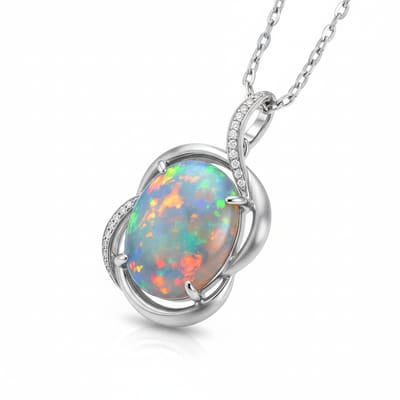
- Setting: The way the opal is set in jewelry is crucial. Due to their relative softness, opals are best protected in bezel or halo settings that shield the edges.
- Source: Australian opals, particularly black opals from Lightning Ridge, are renowned for their quality. Ethiopian opals are also popular.
- Reputation: Buy from reputable jewelers or gem dealers who can provide authenticity and detailed information about the stone.
Price Range & Value Factors
Opal prices can vary dramatically, from a few dollars for small, common opals to hundreds of thousands of dollars for exceptional black opals. Key value factors include:
- Play-of-Color: The intensity, brilliance, and range of colors are paramount.
- Body Tone: Black opals command higher prices than white or light opals due to the contrast they offer.
- Pattern: Unique and desirable patterns (harlequin, flame) increase value.
- Size (Carat Weight): Larger opals are rarer and thus more valuable, but visual appeal can sometimes outweigh size.
- Origin: High-quality opals from renowned sources like Lightning Ridge often fetch higher prices.
- Treatment: Some opals may be treated (e.g., fracture filling) to improve appearance or stability. Treated opals are generally less valuable than natural, untreated stones.
- Rarity: Exceptional color combinations, patterns, and sizes are rare and thus more valuable.
Care and Maintenance
Due to their softness and water content, opals require gentle care:
- Avoid Harsh Chemicals: Never expose opals to soaps, detergents, perfumes, lotions, or cleaning agents, as these can damage the surface or affect the water content.
- Protect from Impact and Scratches: Store opals separately from harder gemstones and jewelry to prevent scratches. Avoid wearing opal jewelry during strenuous activities.
- Maintain Moisture: Opals can dry out and crack in arid environments. If an opal seems dry, it can sometimes be rehydrated by placing it in a damp cloth or a small amount of distilled water for a short period. However, prolonged soaking is not recommended.
- Cleaning: Clean opals with a soft, damp cloth. Do not use ultrasonic cleaners or steam cleaners.
- Avoid Extreme Temperatures: Sudden changes in temperature can cause stress and cracking.
Pros and Cons
Pros:
- Unique and mesmerizing play-of-color.
- Each stone is one-of-a-kind.
- Available in a wide range of colors and price points.
- Celebrated for its beauty and mystique.
Cons:
- Relatively soft and prone to scratching (Mohs 5.5-6.5).
- Can be sensitive to dehydration, chemicals, and extreme temperature changes.
- Requires careful handling and maintenance.
- High-quality, large opals can be very expensive.
Famous Examples
One of the most famous opals is the Rooster's Egg Opal, a black opal found in Lightning Ridge, Australia, celebrated for its brilliant play-of-color.
The Olympic Australis Opal is another legendary Australian black opal, discovered in 1956. It is known for its exceptional size and brilliant, all-around play-of-color.
The Andamooka Rainbow Opal, also from Australia, is a famous matrix opal that was presented to Queen Elizabeth II.
Common Misconceptions
- Opals are always unlucky: This superstition is largely unfounded and has varied across cultures and time periods. Many cultures consider opals symbols of good fortune and hope.
- All opals have play-of-color: While play-of-color is the defining characteristic of precious opal, many opals, like fire opals and common opals, do not exhibit this phenomenon.
- Opals are extremely fragile: While softer than diamonds or sapphires, opals are durable enough for everyday wear if properly set and cared for. They are not inherently too fragile for jewelry.
Related Terms
- Gemstone
- Silica
- Play-of-Color
- Body Tone
- Mohs Hardness Scale
- Black Opal
- White Opal
- Boulder Opal
- Fire Opal
- Amorphous
- Diffraction
FAQs
What is the most valuable type of opal?
Generally, black opals from Australia, particularly Lightning Ridge, are considered the most valuable due to their intense play-of-color against a dark background.
Are opals good for engagement rings?
Opals can be used in engagement rings, but their relative softness requires careful consideration. A bezel setting is highly recommended to protect the edges from chips and scratches. They are also not ideal for individuals with very active lifestyles.
How can I tell if an opal is real?
Real opals exhibit a distinct play-of-color that changes as the stone is moved. Imitation opals, or simulants, often have a uniform, static pattern or look too perfect. Be wary of stones that are excessively cheap or have an unnatural, uniform iridescence.
What does 'play-of-color' mean in opals?
'Play-of-color' refers to the phenomenon where spectral colors appear to move across the surface of an opal when it is tilted. This is caused by the diffraction of light through the opal's microscopic silica spheres.
Can opals be treated?
Yes, some opals undergo treatments to improve their appearance or stability, such as fracture filling to hide cracks or improve clarity. Untreated opals are generally more valuable.